BEWARE THE SCOURGE OF CREEPING INFANTILISATION.

We better do something fast or we’re all heading for a nightmare existence of puerile, primary-coloured, thumb-sucking, purgatory.

Treating adults like kids can be funny – especially when they’re behaving like seven year-olds on a sugar-binge (see House of Commons, Westminster). But the joke wears thin when you realise it’s rapidly becoming the norm whenever a marketer (them) tries to communicate with a potential purchaser (us).

PATRONISING SMILEY VOICE: We asked people to put a price on their hearing. One reply said ‘One hundred trillion pounds because I love music and languages.

The scourge is spreading through every part of the media, but just now I’m going to focus on the world of the radio commercial. Why? Because radio ad producers are among the worst offenders and their low production costs make their sins all the more inexcusable.

SING-SONG VOICE: [Embarrassingly basic intro about uncertain winter weather and the consequent need to buy a new gas boiler.]

PENGUIN: (lovably) Squawk!

SING-SONG VOICE: (chuckle) I thought penguins didn’t get cold Wilbur!

PENGUIN: (lovably) Squawk!

Reproducing the text alone can’t convey the full horror. The infantilism is further heightened by the delivery. Think children’s TV presenters on a cocktail of helium and assorted stimulants and you’re getting close.

And it’s not just businesses that treat us like overgrown toddlers – public service organisations are equally culpable. Take the NHS antibiotics campaign that, on commercial radio, is currently being fronted by a jaunty song.

CHORUS: Antibiotics we’re wonderful pills but don’t ever think we’ll cure all of your ills. [Several more verses follow in similar style.]

So why do they (clients and their ad agencies) do it?

One possible reason is because they believe it works. Some researcher has proved that childishly simplistic ads make your brand, product or service more memorable. They’re probably right – in the same way that having your teeth drilled without anaesthetic is more memorable (see Marathon Man).

And then there’s the (expletive redacted) repetition. This is one of the top characteristics of infantilism. Go to any primary school and witness the teacher, Miss X, reinforce the learning points by repeating them in differing ways. Fine – they’re kids, repetition helps.

Now replace the kids with adults and get Miss X to rerun an identical lesson in exactly the same tone of voice. You’re sitting in the front row (next to Smelly Frankie). Anything seem a little wrong to you? Welcome to Radio Infantile.

Back to the researchers who I’m sure can provide persuasive evidence that repeating a message endlessly, even if it’s as excruciating as finger nails rasping down a chalkboard, will elicit high levels of ‘listener recall’ – the marketer’s delight.

But recall isn’t a victory if it comes with a poisonous cloud of emotional resentment. On the whole, victims don’t grow to love their torturers.

While we’re talking repeats, I’ve got another custard pie I’d like to fling. The production cost of most radio commercials is relatively low, making it possible to produce far more variants within a campaign. And yet we’re subjected to long runs of identical ads.

If you happen to keep the radio on for an hour or more, as many people do while they’re working, driving or at home doing other useful things, you’re exposed to a large number of ad breaks. If each of those breaks are filled with identical ads (as they so often are), the most mild-mannered listener will begin to seethe.

Another possible reason for the viral spread of infantilism is that advertisers think they’re being ironic. Hey, we know we might seem to be insulting your intelligence but you know we’re only kidding right? Of course you do. We’re just having a little fun with you – ha ha!

Sorry, that doesn’t wash either. Sure, irony has a strong British tradition but to pull it off successfully while trying to sell something takes actual skill (see The Meerkats from Meerkovo). The radio ads in my crosshairs sound like they’ve been hashed together in a lift between floors one and two.

Now I accept that all this could be ‘just me’ and who the heck, aside from obsessive copywriters, listens to radio ads that critically anyway? Aren’t they just advertising flotsam that most people mentally switch off from while waiting for their programme to resume?

And why get so uptight about infantilisation in an age of skateboarding cats and ritual unboxing? Don’t we all need some light relief in a harsh world?

No, and No. Radio advertisers and their agencies are in a privileged position. We let them into our homes and give them access to our ears. That’s pretty personal. Whatever they’re trying to sell us, we deserve to be treated with respect and, at the very least, that means treating us like adults.


WHAT’S IN A VOICE?

A lot. And if you’ve heard the way Timothy Spall says the name Wickes in the company’s latest TV commercials – you’ll know what I mean.

In a past life I had to direct scores of voice-overs – mainly for business-to-business or business-to-employee videos and presentations. I trotted up and down to London studios to record voice artistes who could earn in an hour what I earned in a week.

I’d written the scripts in most cases, and soon learned what worked and what didn’t from the talented beings who read my words. Most of them were well-known stage and screen actors who were either resting or paying their bar bills. It must have been trying for them to be squeezed into a booth and bleated at by some upstart when a few days before they were the toast of Theatreland or relaxing between takes.

I have to say though, they rarely showed any irritation. Mind you, they were good actors – which gets me back to Timothy Spall. I’m not sure if by the time you read this post the Wickes TV ads will still be running, but if they are, listen carefully to the way he says Wickes at the end. Somehow he manages to invest that simple little name with a host of meanings and associations.

First off – he pitches it as the only possible recourse for anyone wondering where they’re going to get everything they need to construct a great bathroom or kitchen or whatever. But it’s more than that. The word Wickes, when interpreted by Mr Spall, also expresses something like: Of course! It’s obvious! Why on earth didn’t I think of them before?

And we’re not just talking about subtleties of meaning; the natural warmth of his friendly-uncle-voice seems to shine a beam of golden sunlight into the gloomy mega-sheds of the DIY universe – and that’s reassuring for people with a morbid fear of grout.

You probably know that we copywriters spend a deal of time arguing and fretting about tone of voice. This is because, regardless of whether words are taken into the brain through ears or eyes, they can entice or repel your punter in an instant.

They say job applicants are judged in the first 15 seconds of an interview. In marketing communication you don’t get that long and, unlike an interview panel, nobody has any obligation to stick around and feign interest. The lesson is clear – get the voice right and you’re at least halfway there.

With effusive apologies to the brilliant Frank Carson, the way you tell ‘em really does make the difference.

HOLBY – YOU MUST BE JOKING.

Last night I watched BBC soap Holby City and realised that Auntie is missing a huge trick…

I’m not a soap addict but this has nothing to do with snooty cultural pretensions (I avoid opera like the plague too) –- it’s just that most soaps depress the living hell out of me. Maybe it’s something to do with seeing the same set of characters grinding through the same conflicts in the same grinding environment.

But last night, thanks to a finger-brain malfunction involving my baffling TV remote, I accidentally selected Holby City and, before I could rectify my unfortunate slip, caught a few seconds of it. That’s all it took, because we (my better half got caught too), kept watching to the end credits. Why? Because it was a riot.

The format was the usual intercut triple storyline with some light character-arcing around the edges to keep the few people who care about that stuff (ie: the Holby script editors) happy.

Story ‘A’ featured two female surgeons who were trying to out-bitch each other while not really tending to a toddler who had fired some nails into his heart using his handyman father’s nail gun — I blame all that sodding decking.

Story ‘B’ featured a senior male surgeon lumbered with looking after his baby son (or was it his grandson?) and not really on scalpel duty but nevertheless pressured into conducting a risky op on a woman who wanted him to ‘let her go’ if things got messy while her sullen daughter (prone to regular stormings off) wanted her mother to be kept going no matter what.

Story ‘C’ involved a senior nurse and a newly appointed junior doctor who tried to out-bitch each other while not really tending to a group of old hags who had poisoned themselves by drinking out of dodgy lead-lined cups –- I blame the Antiques Roadshow.

The script was cliché-ridden awfulness, the acting would have been embarrassingly over-the-top in a seaside panto, the direction was sub-Teletubby. All in all it was a joy.

There were so many high spots it seems unfair to pick out any in particular, but the moment when the two female surgeons paused for what seemed like minutes to glower and slag each other off in the middle of a delicate keyhole procedure to remove three-inch nails from the aforementioned tot’s ventricle, was side-splitting.

So too was the scene in the ladies loo when the newly appointed junior doctor (who was topping up her mascara) told the senior nurse that she was quite pretty really and all she needed was some expert help with her blusher.

Oh – and when the slightly more bitchy of the two bitchy surgeons told a junior that he couldn’t perform operations until he’d spent a day learning to do that trick where you roll a coin across the top of your knuckles.

Marvellous. This is what makes our huge licence fee bearable. There’s just one suggestion I’d make to the BBC Drama team, be generous and hand this property over to Comedy –- they haven’t got anything remotely funny at present and Holby could be their salvation.

VORSPRUNG DURCH BIG ARTY SUPPLEMENTS…

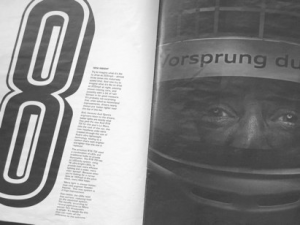
I’ve got mixed feelings about Audi’s indulgent piece celebrating their win at Le Mans.

Grainy-looking black and white photography (rubber streaked tarmac has never looked so sexy), oodles of fancy typography and hectares of empty space – you’d think we’d time-slipped back to the sixties when companies weren’t so afraid of using ‘art’ as a marketing tool.

Part of me wants to congratulate Audi in having the nerve to produce this item. It must have cost them a fat wedge – although nothing compared to the bill for developing and running three competitive Le Mans cars. But the other half of me (the bitter half that is), gets a bit warm under the collar at the way they’ve mistreated the copy.

The words themselves are actually rather good. All copywriters think they can do better than the other guy and I’m no exception, but I think the credited writer, Mike Duff, has done a fine job. My personal red mist began to form when I opened the cover and saw the typesetting and layout on the first double page.

In short, the text was too wide, too bold, too big and too blocky. Consequently, I found it too difficult to read. I turned the page and found the designer had now set the body copy in a smaller display face with a line running through it to make the letters even more illegible.

This sin was then compounded throughout the supplement with each block of text being artfully squished and/or rendered in a multitude of faces. I’m sure some designers would say this was being brave and I’m all for breaking with convention – but not if this means making the thing unreadable.

The moral? Designers should try reading the text they’re working with after they’ve positioned it in their design, and preferably in the form and size in which the final product will be released. An image on paper is very different from the same image displayed on the designer’s screen, and this alone can create a whole stack of problems.

Above all, designers should remember that words aren’t just panels of greyish, squiggly-textured fill that have to be grudgingly accommodated; they have an essential part to play and it’s the designer’s job to help them do it. Of course, copywriters aren’t exactly blameless either – but more on that another time.

WHY THE MEKON MUST DIE.

It’s time to fess up. I’ve written Mekon for money and I’m deeply, deeply ashamed.

And it’s no use you acting all innocent either. How many of you corporate wunderkinder can say you’re completely untainted by leaden dirges such as:

Our Consumer Exploitation Division experienced high demand in the first quarter. However, margins were significantly eroded by continuing rises in materials and transport costs. We expect this trend to continue well into the next period with new compliance legislation exerting further blah blah. Please continue for another 40 pages or until you lose the will to live.

So what’s my excuse? Well, I still write Mekon on occasion because it’s just not worth the intense psychological pain of trying to change corporate mindsets, and even copywriters need to eat. I also kid myself that at least I’ll be able to take the edge off it by sneaking in a human touch or two.

But, aside from upsetting the delicate sensibilities of word pushers like me, does it really matter in the great scheme of things that organisations choose to communicate using industrial quantities of turgid gobbledegook? I can think of three reasons why the answer is an unreserved yes…

First, fewer people actually read the stuff because by the end of the third sentence they’re catatonic – this excludes them from the communication process. Second, Mekon (like its merciless alien progenitor), is purpose designed for obfuscation and deception. In the wrong hands it can mean just about anything, which is why politicians love it to bits.

The third and probably most disturbing reason is that Mekon is usually anonymous. As those moodily-lit CSI people would say, the evidence contains no identifiable human DNA. The trouble with anonymity is that nobody takes responsibility – and organisations which encourage that kind of culture are heading for some nasty surprises.