Interviews
From researching a brief to writing a feature, effective interviewing is a copywriter's must-have.
In my job I've been lucky enough to interview some fascinating individuals (sometimes on the other side of the globe), and most of them have been incredibly helpful and generous with their time. It's always great to meet people who really know their stuff.
Probably the single most important quality an interviewer needs is a genuine interest in their subject. There are also many useful interviewing techniques, including the famous 'Columbo Ploy'. (I'll be spilling the beans about that one in iRant.)
In my job I've been lucky enough to interview some fascinating individuals (sometimes on the other side of the globe), and most of them have been incredibly helpful and generous with their time. It's always great to meet people who really know their stuff.
Probably the single most important quality an interviewer needs is a genuine interest in their subject. There are also many useful interviewing techniques, including the famous 'Columbo Ploy'. (I'll be spilling the beans about that one in iRant.)
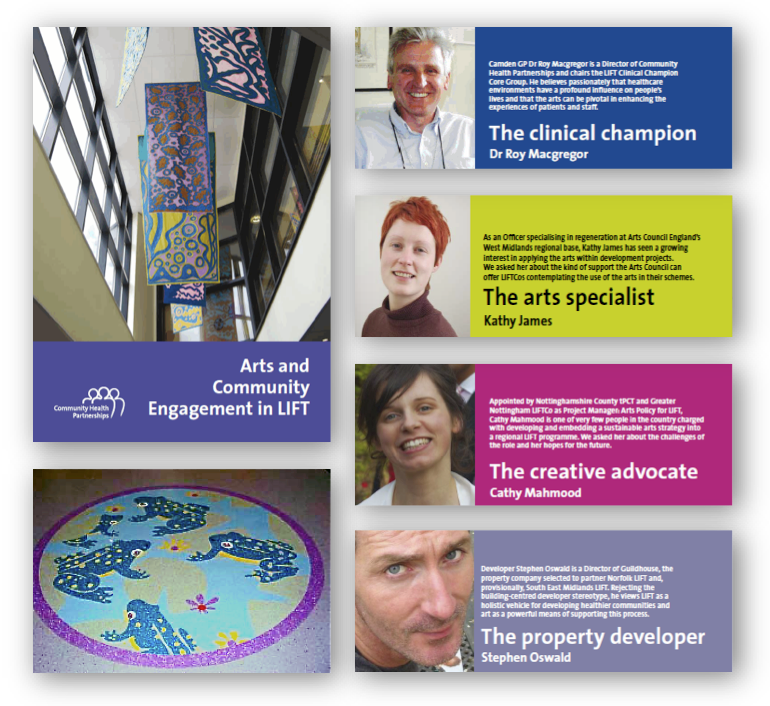
The Clinical Champion
Dr Roy Macgregor
You obviously feel very strongly about design and the arts - what inspired your interest?
I'm just passionate about buildings and architecture and I believe they can genuinely enhance the human life experience. We all live in a pretty stressful world and people coming to see the doctor are often in a stressful state and I think it's inexcusable not to provide an uplifting environment when it's so relatively easy to do that. I would go so far as to say that it's almost amoral to provide services out of a drab block or a depressing portable cabin when you can provide the same services out of what could effectively be considered an art gallery.
How do GPs perceive the use of art in healthcare settings?
I think on the whole they probably start off by just thinking of it as pictures on the wall. But as they get more involved in the design of a building they begin to see that art can play a role in not just making it a pretty place to be but in enhancing the experience of the patient. I believe we should extend the word ‘art’ to encompass the use of colour, texture, materials, furnishings, even sound – everything that creates an environment which is sympathetic to the patient experience.
What kind of practical effects can art have on patients?
One example might be a patient coming into a centre where you had a ‘rotating’ art display which is regularly renewed. Rather than dreading his 3 monthly blood test for cancer checks, he will begin to think – ‘I wonder what they’ll have on display this time?’ – so you’re helping to reduce anxiety. Alternatively, a patient who has come in for a repeat prescription in a busy lunch hour and finds the local school music quartet playing in the waiting room will regard the visit as a pleasurable interlude rather than a chore. And by capturing interest and encouraging people to stay just a little longer in the centre you can often get a secondary health gain.
Dr Roy Macgregor
You obviously feel very strongly about design and the arts - what inspired your interest?
I'm just passionate about buildings and architecture and I believe they can genuinely enhance the human life experience. We all live in a pretty stressful world and people coming to see the doctor are often in a stressful state and I think it's inexcusable not to provide an uplifting environment when it's so relatively easy to do that. I would go so far as to say that it's almost amoral to provide services out of a drab block or a depressing portable cabin when you can provide the same services out of what could effectively be considered an art gallery.
How do GPs perceive the use of art in healthcare settings?
I think on the whole they probably start off by just thinking of it as pictures on the wall. But as they get more involved in the design of a building they begin to see that art can play a role in not just making it a pretty place to be but in enhancing the experience of the patient. I believe we should extend the word ‘art’ to encompass the use of colour, texture, materials, furnishings, even sound – everything that creates an environment which is sympathetic to the patient experience.
What kind of practical effects can art have on patients?
One example might be a patient coming into a centre where you had a ‘rotating’ art display which is regularly renewed. Rather than dreading his 3 monthly blood test for cancer checks, he will begin to think – ‘I wonder what they’ll have on display this time?’ – so you’re helping to reduce anxiety. Alternatively, a patient who has come in for a repeat prescription in a busy lunch hour and finds the local school music quartet playing in the waiting room will regard the visit as a pleasurable interlude rather than a chore. And by capturing interest and encouraging people to stay just a little longer in the centre you can often get a secondary health gain.
.....
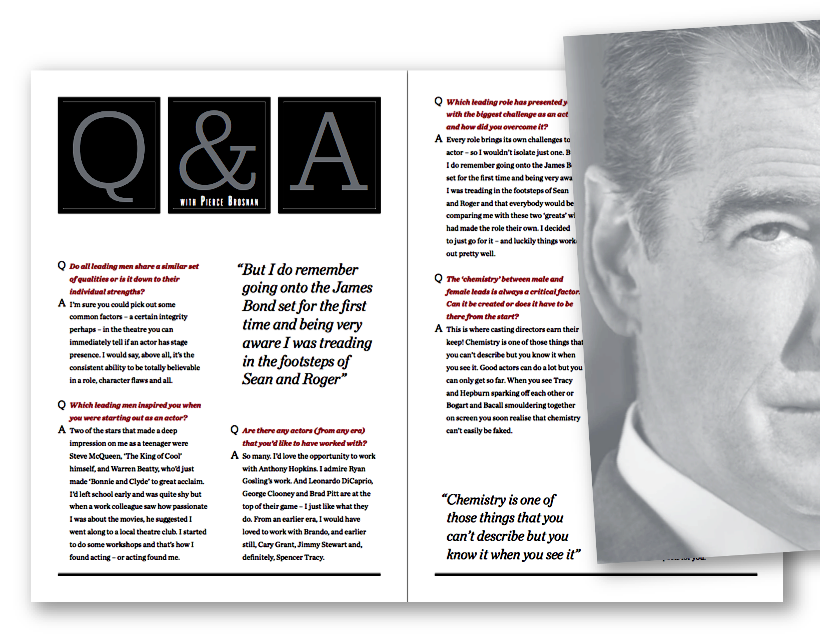
Q&A with Pierce Brosnan
Which leading role has presented you with the biggest challenge as an actor and how did you overcome it?
Every role brings its own challenges to an actor – so I wouldn’t isolate just one. But I do remember going onto the James Bond set for the first time and being very aware I was treading in the footsteps of Sean and Roger and that everybody would be comparing me with these two ‘greats’ who had made the role their own. I decided to just go for it – and luckily things worked out pretty well.
The ‘chemistry’ between male and female leads is always a critical factor. Can it be created or does it have to be there from the start?
This is where casting directors earn their keep! Chemistry is one of those things that you can’t describe but you know it when you see it. Good actors can do a lot but you can only get so far. When you see Tracy and Hepburn sparking off each other or Bogart and Bacall smouldering together on screen you soon realise that chemistry can’t easily be faked.
Which leading role has presented you with the biggest challenge as an actor and how did you overcome it?
Every role brings its own challenges to an actor – so I wouldn’t isolate just one. But I do remember going onto the James Bond set for the first time and being very aware I was treading in the footsteps of Sean and Roger and that everybody would be comparing me with these two ‘greats’ who had made the role their own. I decided to just go for it – and luckily things worked out pretty well.
The ‘chemistry’ between male and female leads is always a critical factor. Can it be created or does it have to be there from the start?
This is where casting directors earn their keep! Chemistry is one of those things that you can’t describe but you know it when you see it. Good actors can do a lot but you can only get so far. When you see Tracy and Hepburn sparking off each other or Bogart and Bacall smouldering together on screen you soon realise that chemistry can’t easily be faked.
.....
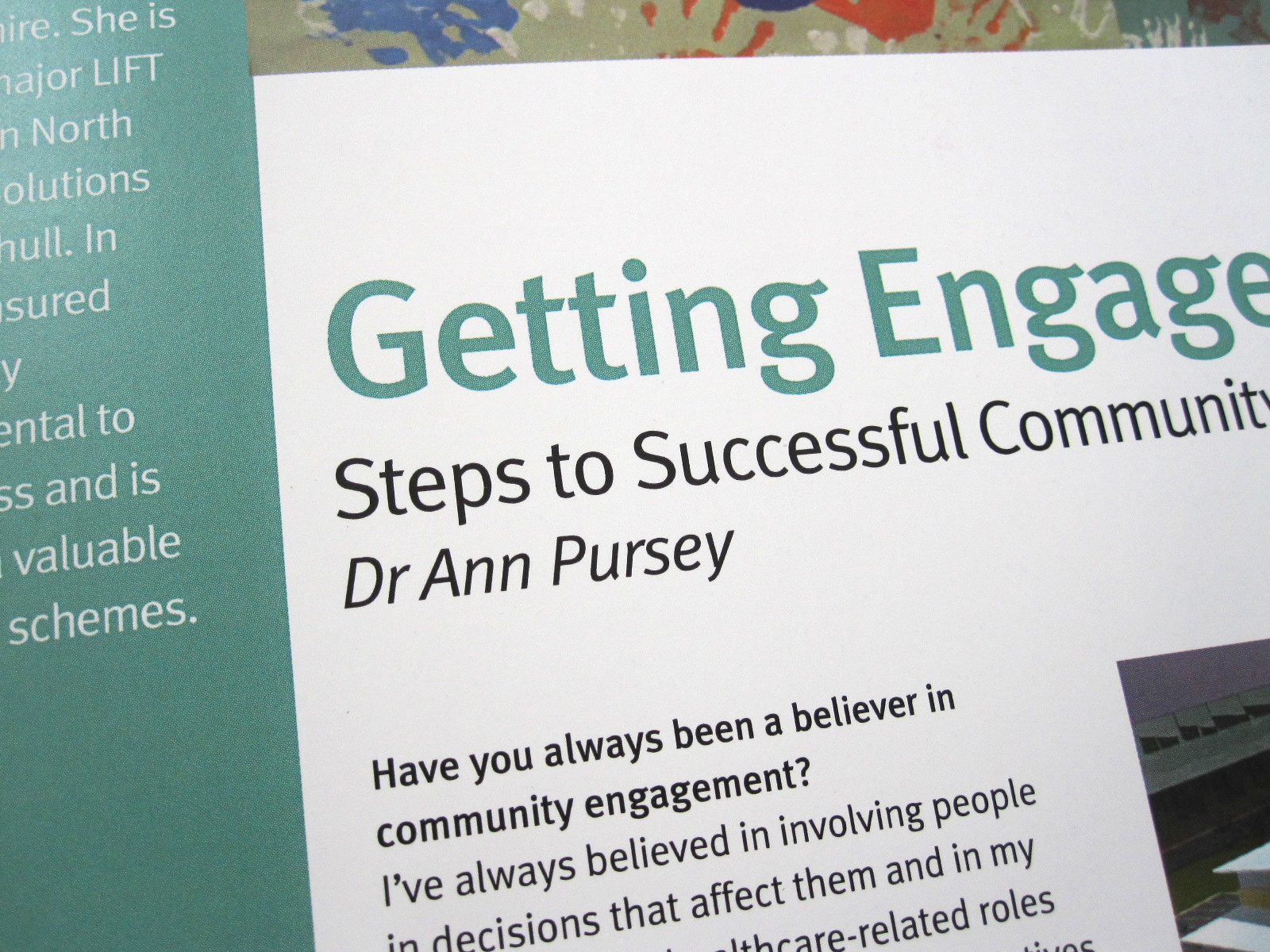
Getting Engaged – Steps to Successful Community Partnership
Dr Ann Pursey
Have you always been a believer in community engagement?
I've always believed in involving people in decisions that affect them and in my NHS and other healthcare-related roles consultation with patient representatives and other community groups was standard practice. But consultation isn't the same as engagement and it wasn't until I joined Prima 200 that I learned to appreciate the difference that real engagement with communities can make.
Isn't engagement mainly about listening to people?
Listening and learning is a big part of it and much of that is quite intuitive and unstructured – people don't communicate in straight lines and you have to be prepared to go where they lead you. But we also wanted to get people more positively involved so they could have real input into the new scheme and start to own it. To help us do this we started a creative consultation programme in addition to our continuing dialogue with community groups.
Dr Ann Pursey
Have you always been a believer in community engagement?
I've always believed in involving people in decisions that affect them and in my NHS and other healthcare-related roles consultation with patient representatives and other community groups was standard practice. But consultation isn't the same as engagement and it wasn't until I joined Prima 200 that I learned to appreciate the difference that real engagement with communities can make.
Isn't engagement mainly about listening to people?
Listening and learning is a big part of it and much of that is quite intuitive and unstructured – people don't communicate in straight lines and you have to be prepared to go where they lead you. But we also wanted to get people more positively involved so they could have real input into the new scheme and start to own it. To help us do this we started a creative consultation programme in addition to our continuing dialogue with community groups.
.....